
I love hoppy beers. So much so that, once upon a time, I became an avid homebrewer because I found the beers in Belgium just weren’t hoppy enough for my taste (sorry Belgium — I still love the chocolate!). What I didn’t love as much was learning that one of the key components responsible for those bold hop flavours, β-myrcene, is listed under California’s Proposition 65 due to evidence of carcinogenicity in animal studies with no derived safe harbour level (as found here).
What is β-Myrcene? 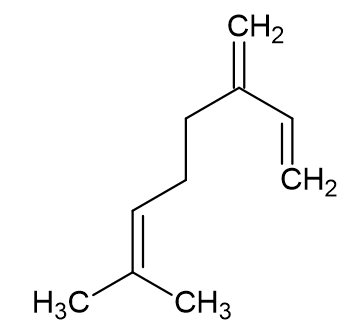
β-Myrcene is a naturally occurring botanical compound. It has a musky, spicy, and sometimes fruity flavour profile, reminiscent of mango or red grape. It is found in essential oils of plants like bay, parsley, cardamom, and especially hops. In Citra hops, one of my favourites, it appears at concentrations of 1.2% to 4.5%. It is ubiquitous and intake from its use as a food additive based on annual volume of production is estimated at 290 µg/d (EFSA, 2015).
Why the Concern?
“Hang on, but it’s carcinogenic!” I hear you cry – “We should be keeling over! Quick, put this Prop 65 warning on it!”. Toxicology is more than just what we see in human, animal, and cellular studies. As the father of toxicology once said all the way back in 1541; “the dose makes the poison”. Identifying risk is equal parts health hazard of a substance and exposure to said substance. This can be a double-edged sword though – everything, even substances perceived as “natural” can be dangerous at high enough levels.
Back to the case of β-myrcene. Initially it was Generally Recognized as Safe by the FDA as a food additive (21 CFR 172.515) but has since been removed after petitioning by NGOs citing the Delaney Clause given that β-myrcene was shown to be carcinogenic in rats and mice in studies undertaken by the National Toxicology Program (NTP) in 2010.
The Delaney Clause mandates that the FDA ban any food additive found to induce cancer in humans or animals. This zero-tolerance policy means that even a negligible risk of cancer due to a food additive is not allowed, regardless of how small the risk may be. Given how exposure drives risk, you can see how outdated such an approach would be.
The FDA stated that β-myrcene did not demonstrate genotoxic potential and was unlikely to induce tumours in humans at its current exposure level as a food flavouring chemical, but had to ban it, nonetheless. The European Food Safety Authority (EFSA) has concluded that β-myrcene did not pose risk at current use levels leading to an intake of 290 µg/d (EFSA, 2015).
What Did the Animal Studies Show?
So, is it safe? Is it unsafe? Let’s look under the bonnet and see what the NTP studies entailed. Mice and rats were orally administered 0, 250, and 500 mg/kg bw/d β-myrcene 5 days a week for 2 years (or 0, 178, and 357 mg/kg bw/d when accounting for dosing schedule) (National Toxicology Program, 2010). The results showed that there was an increased incidence of renal tubule adenoma or carcinoma in treated male rats. Furthermore, there was clear evidence of a dose-dependent increase in hepatocellular adenoma, hepatocellular carcinoma, and hepatoblastoma in male B6C3F1 mice (IARC, 2019).
Table 1: male rat – renal tubule adenoma or carcinoma (combined)
| Dose (mg/kg bw/d) | Group size | Tumour incidence |
| 0 | 50 | 0 |
| 178.571 | 50 | 14 |
| 357.143 | 50 | 13 |
Table 2: male mouse – hepatocellular adenoma, carcinoma, or hepatoblastoma
| Dose (mg/kg bw/d) | Group size | Incidence |
| 0 | 50 | 34 |
| 178.571 | 50 | 45 |
| 357.143 | 50 | 48 |
There have been arguments put forward that renal tumours in the male rats were possibly due to α2u-globulin nephropathy (Surendran et al., 2021). This male rat-specific mechanism is not applicable to humans, as the protein α2u-globulin responsible for this effect in rodents is not present in humans and would therefore render the rat data as irrelevant to human health. It should be highlighted that such a conclusion was not reached by other agencies. Specifically, the NTP concluded that the mechanism was not clear since several lines of evidence suggested that β-myrcene might cause nephrotoxicity by a mechanism other than, or in addition to, α2u-globulin nephropathy (National Toxicology Program, 2010). Similarly, the International Agency for Research on Cancer (IARC) concluded that it did not meet criteria for a α2u-globulin-associated response given that
1) tumours and nephropathy were induced by β-myrcene in female rats (albeit not at statistically significant levels);
2) no data were available on the binding of β-myrcene or its metabolites to α2u-globulin;
3) induction of sustained increase in cell proliferation in the renal cortex was not demonstrated; and
4) hyaline droplets were not seen at the highest dose, and α2u-globulin protein was not quantified
For the mouse data, there have been arguments that given that spontaneous tumours were also observed in the vehicle control group which is unsurprising given that male B6C3F1 mouse is known for having a high background incidence of hepatocellular tumours, the mouse data should not be considered (Surendran et al., 2021). While technically true that male B6C3F1 mice have high level of spontaneous liver adenoma and carcinoma (mean of 10.2% and 12.5% in 2-year studies (Eiben, 2001)), hepatocellular adenoma and carcinoma incidence in the NTP study were far higher than background incidence. Additionally, hepatoblastomas observed after treatment with β-myrcene are rare tumours in B6C3F1 mice, with background incidences of 1.6% in male mice (Turusov et al., 2002).
Ultimately, the precautionary principle would indicate that we do not ignore this data. What can we all agree on then? Well, rather importantly, β-myrcene is not genotoxic. This can have huge ramifications when it comes to derive a dose with reasonable safety. β-Myrcene has consistently been shown to not be genotoxic in cellular assays and in rodents, with only a slight but non-dose-dependent induction of exchanges of genetic material between sister chromatids in one assay. β-Myrcene was concluded to not be genotoxic by the NTP, IARC, FDA, and EFSA.
Risk Assessment: Deriving a Safe Dose
So, we have mouse and rat tumour data for β-myrcene, we know it is not genotoxic, but we don’t have an officially established “safe” dose, and it is banned by the FDA? Correct, that is where things stand now. But we are here to do scientifically robust risk assessment. After all, I want to know what sort of risk I have – and will be – putting my body through for years of hopefully enjoying those delicious beers. Enter the benchmark dose approach which analyses the dose-response data from toxicity studies in experimental animals to derive a reference dose with reasonable safety that can be used of risk assessment. Briefly, the approach aims to identify a dose from a dose-response curve that produces a predetermined change in the response rate of an adverse effect – in this case and increase in tumours brought about by β-myrcene. Traditionally, the No Observed Adverse Effect Level was used to identify the highest dose tested in a study without evidence of an adverse effect. Instead, benchmark dose approach utilises the whole dose–response curve to identify a dose associated with a specified change in response relative to the control group (background response). Another benefit using the benchmark dose approach is that it provides a quantification of the uncertainty in the estimated reference dose. The lower bound (or BMDL) of the benchmark response is considered as a robust reference point for risk assessment. EFSA has recently updated its guidance of using of the benchmark dose approach in risk assessment (EFSA, 2022).
When using the mouse and rat tumour data, a benchmark response of 10% (that is a 10% increase in the incidence or severity of an adverse effect compared to the background level in a control group) and Bayesian model averaging, the following analysis can be derived:
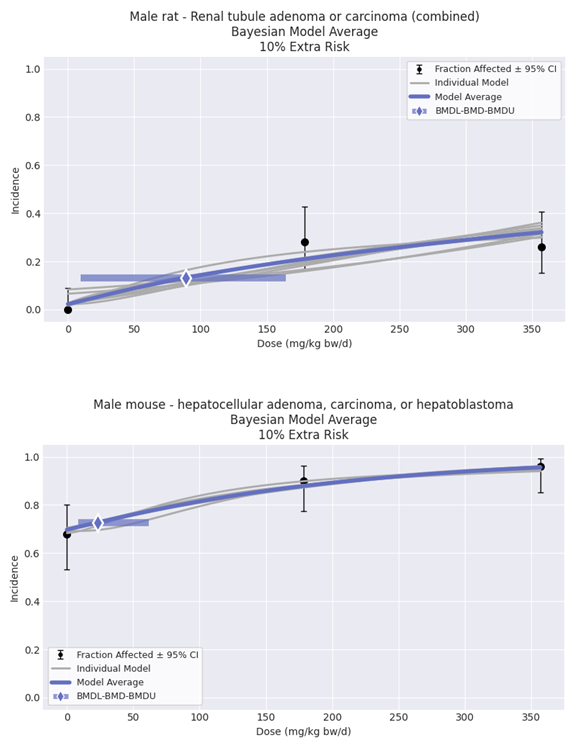
Figure 1: Benchmark dose modelling results for male rat (top pane) and male mouse (bottom pane) tumour data
The rat data returned a BMDL of 9.57 mg/kg bw/d, with a credible interval (a measure of uncertainty around the benchmark dose estimate) of 9.57 – 164.19 mg/kg bw/d. The mouse data identified a BMDL of 8.77 mg/kg bw/d with a credible interval of 8.77 – 61.70 mg/kg bw/d. Ultimately what this is saying is that the mouse was slightly more sensitive to β-myrcene induced carcinogenesis, and there is higher confidence in the mouse BMDL of 8.77 mg/kg bw/d.
It is commonplace to include a safety factor of 100 to account for animal and human variability within and between species. This leads to a maximal dose of 0.0877 mg/kg bw/d that can be supported for sufficient safety. As a measure, if it turned out that β-myrcene was genotoxic, then a non-threshold dose response should be assumed (i.e. there is no safe level of exposure), and the reference dose that can be used for risk assessment would equate to 0.00021 mg/kg bw/d, highlighting the importance of moving beyond a simplistic ‘cancer: yes or no?” view and how such simplistic views of complex systems can lead to inaccurate policy action.
My Beer and Me: How Much Am I Exposed To?
Okay so we have a dose of 0.0877 mg/kg bw/d where a sufficient level of safety can be supported. How close am I getting to that dose, or am I even exceeding it when enjoying my hoppy beers?
Going back in my recipe book, I saw that I was adding up to 515 g of my favourite hop variety that contains 1.2 – 4.5% β-myrcene in 20L of beer (the usual amount of beer when homebrewing, no judging!). That would equate to a final concentration of 309 – 1159 mg β-myrcene per litre of beer! I am in trouble when assuming my body weight of 90 kg (again, no judging!) as it would indicate I was consuming 0.49 – 1.84 mg/kg bw/d if I was drinking just 1 litre a week, or 6 – 21 times more than the safe dose!
But β-myrcene is volatile and chemically unstable. There is evidence to suggest that only 8% of the β-myrcene added during the brewing process is retained in the final beer (Salamon et al., 2022). β-Myrcene is also highly insoluble, with a water solubility of 5.06 mg/L at 20 oC (funnily enough the temperature I was hopping my beer at). The final concentration of 309 – 1159 mg β-myrcene per litre of beer is therefore unlikely.
If we assume that the concentration of β-myrcene did not exceed its solubility of 5.06 mg/L in water, a rather safe assumption, then I could in theory drink 1.5 L of my extremely hoppy, 8% ABV beer per day. I was far below that even when accounting for background exposure through diet (290 µg/d as determined by EFSA), so I am safe, right!? Not quite. Considering an ABV of 8% and a serving of 440 mL (the size of the cans these beers usually come in), that is 3.52 units of alcohol, or 28.16 mg of pure alcohol per can. There is no “safe” level of alcohol consumption, but those units quickly rack up before reaching the limit of 14 units for low risk as determined by the UK’s NHS.
Final Thoughts
 So, should hoppy beer lovers be worried about β-myrcene? The answer is: probably not. With its lack of genotoxicity and extremely low solubility in beer, actual exposure levels are far below thresholds of concern.
But what is worth worrying about is the alcohol content. While natural compounds like β-myrcene can pose risks at high doses, the evidence-based risk in your pint is minimal — and the bigger health risk remains alcohol itself.
Moral of the story: Nature isn’t inherently safe, but with science-based risk assessment, we can enjoy our beers with knowledge and confidence.
Owing to expertise in a number of relevant fields. kriTOX can help you define the best strategy for your products. Please click here should you need more information about services.
Published by Boris Krivoshiev, PhD – Founder and Principal Toxicologist at kriTOX
References
EFSA (2015). Scientific Opinion on Flavouring Group Evaluation 78, Revision 2 (FGE. 78Rev2): Consideration of aliphatic and alicyclic and aromatic hydrocarbons evaluated by JECFA (63rd meeting) structurally related to aliphatic hydrocarbons evaluated by EFSA in FGE. 2. EFSA J. 13, 4067.
EFSA (2022). Guidance on the use of the benchmark dose approach in risk assessment. EFSA J. 20, e07584.
Eiben, R. (2001). Frequency and time trends of spontaneous tumors found in B6C3F1 mice oncogenicity studies over 10 years. Exp. Toxicol. Pathol. 53, 399–408.
IARC (2019). Some chemicals that cause tumours of the urinary tract in rodents.
National Toxicology Program (2010). NTP technical report on the toxicology and carcinogenesis studies of beta-myrcene (CAS No. 123-35-3) in F344/N rats and B6C3F1 mice (Gavage studies). Natl. Toxicol. Program Tech. Rep. Ser. 1–163.
Salamon, R.V., Dabija, A., Ferencz, Á., Tankó, G., Ciocan, M.E., and Codină, G.G. (2022). The effect of dry hopping efficiency on β-myrcene dissolution into beer. Plants 11, 1043.
Surendran, S., Qassadi, F., Surendran, G., Lilley, D., and Heinrich, M. (2021). Myrcene—what are the potential health benefits of this flavouring and aroma agent? Front. Nutr. 8, 699666.
Turusov, V.S., Tor, M., Sills, R.C., Willson, G.A., Herbert, R.A., Hailey, J.R., Haseman, J.K., and Boorman, G.A. (2002). Hepatoblastomas in mice in the US National Toxicology Program (NTP) studies. Toxicol. Pathol. 30, 580–591.